The Thesis
Why We Built the Discovery Queue
A deep dive into how Metal Games uses a Steam-modeled discovery queue, vote-driven leaderboards, and market-aware wishlist simulations to find the next game worth building — before a single line of production code is written.

The Problem
Indie Games Have a Discoverability Crisis
Steam receives over 14,000 new releases per year. The average indie title sells fewer than 1,000 copies in its first month. Not because these games are bad — but because they never get seen. The storefront is so crowded that even great ideas drown in noise before anyone has a chance to evaluate them.
Traditional game jams solve the "build something" problem but not the "would anyone care?" problem. You prototype for 48 hours, post to itch.io, and hope for the best. There's no structured way to test whether your concept has real market appeal before committing months of development.
We asked a different question: What if we could simulate the entire storefront experience — discovery, wishlisting, market validation — at the idea stage?
The Inspiration
Steam's Discovery Queue: The Gold Standard
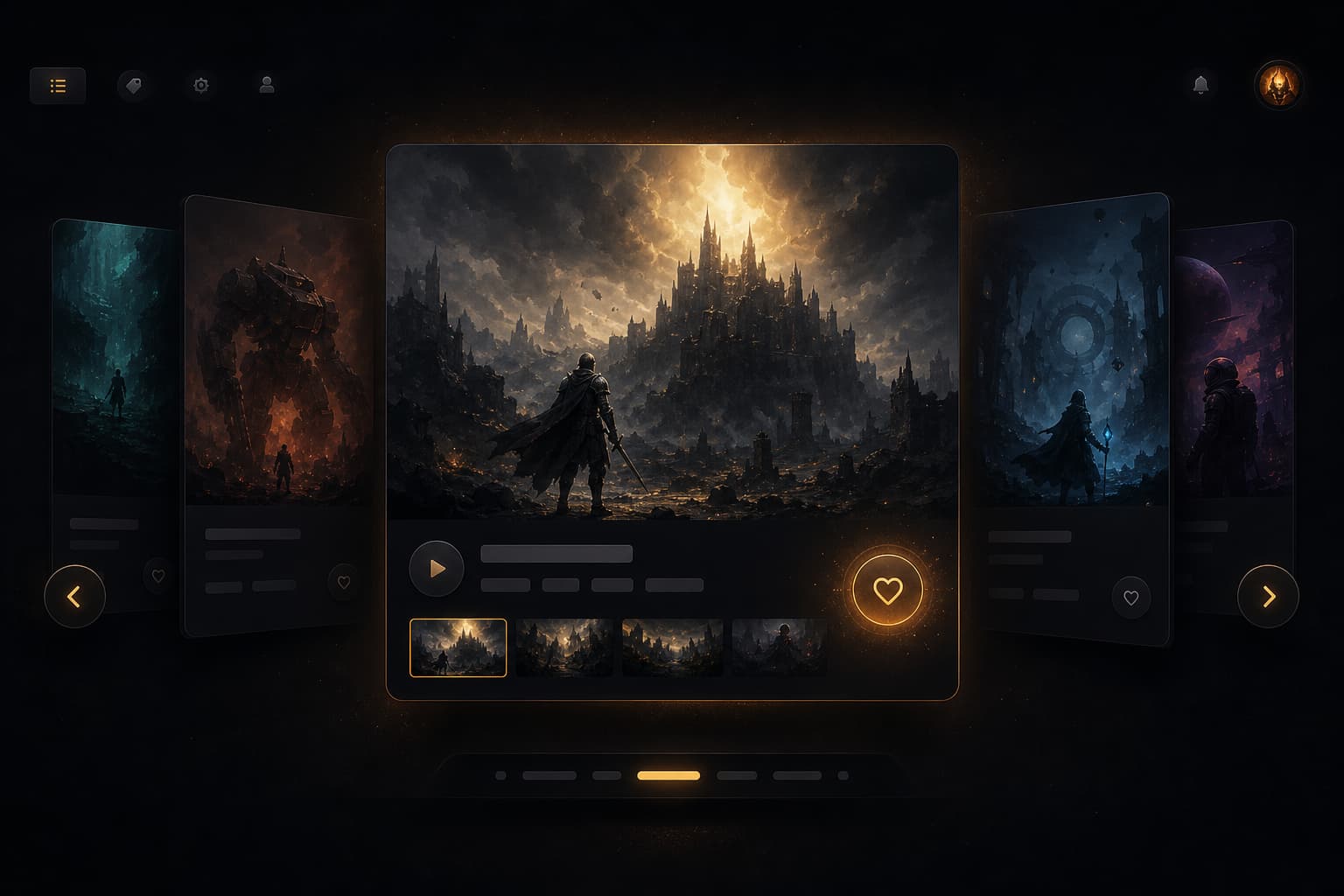
Valve's Discovery Queue is one of the most effective game recommendation systems ever built. When you open your queue on Steam, you're presented with a curated sequence of games — one at a time, full-screen, with all the context you'd need to make a decision: screenshots, trailers, tags, reviews, and a single decisive action — "Add to Wishlist" or "Next".
This UX pattern works because it solves three problems simultaneously:
Forced Attention
One game at a time. No grid of tiny thumbnails. No scroll fatigue. Each submission gets a full-screen moment to make its case.
Low-Friction Voting
A single "Add to Wishlist" button. No rating scales, no review forms. Binary signal — interested or not — that scales to millions of users.
Rich Context
Every game is presented with the same asset set: capsule art, screenshots, tags, and description. Standardized presentation means fair comparison.
Steam's system generates billions of data points about player interest. We don't need billions — we need enough signal to tell which of our ideas has the best shot at market success.
Our Adaptation
The Metal Games Discovery Queue
Every game jam submission on Metal Games goes through the same pipeline that a real Steam release would. That means each entry needs the full asset set:
Required Assets Per Submission
920×430 — Steam header capsule art
748×896 — Steam vertical capsule art
4–8 in-game or concept screenshots
30–60 second gameplay or pitch video
Real tags from the Steam taxonomy
About, features, system requirements
This isn't busywork — it's the point. By requiring Steam-grade assets at the concept stage, we force every idea through the same lens a real customer would use. If you can't make your game look compelling in a store capsule, that's a signal worth catching before you invest months of development.
The queue presents each submission one at a time — header capsule front and center, tags below, screenshots in a gallery, and two buttons: "Add to Wishlist" and "Next in Queue". Wishlists are authenticated and saved to the vote ledger.
Ranking
Vote-Driven Leaderboard
The leaderboard is deliberately simple. Rank is determined by a weighted score:
Ranking Formula
Score = Votes × 100+QA × 10+Fairness × 5
Votes dominate. QA and fairness are tie-breakers, not gatekeepers.
Votes are the primary signal. This is intentional — we want the ranking to reflect genuine interest, not committee score inflation. The QA score measures submission completeness (are assets present? is the manifest valid?), and the fairness score checks for balanced evaluation criteria. Both exist to normalize, not to override.
The leaderboard sits below the discovery queue as a compact table — rank, title, votes, status. Click any row to load that game in the queue. It's a live scoreboard that updates as votes come in.
🏆Why Votes First?
Rating systems are noisy at small scale. A 5-star average with 3 reviewers tells you nothing. But "47 people wishlisted this out of 200 who saw it" is a conversion rate — the same metric real studios use to predict commercial viability on Steam.
The Secret Weapon
Wishlist Simulations with Real Market Data
Here's where it gets interesting. Human votes alone are limited by the size of our community. In the early days, we might have a handful of real users browsing the queue. That's not enough signal to make production decisions.
So we built a wishlist simulation engine — a pool of synthetic users whose voting behavior mirrors real Steam market dynamics.

How the Simulation Works
Ingest Live Steam Data
We pull real-time signals from multiple sources: SteamSpy (genre trends, ownership estimates, concurrent users), Steam Charts (top wishlisted, trending titles), SteamDB (follower counts, tag velocity), and the Steam Store API (tag browsing, new & trending feeds).
Build User Archetypes
The sim creates persona buckets — "genre loyalists" who favor specific tag clusters, "hype chasers" who follow trending categories, "niche seekers" who gravitate toward underserved tags. Each archetype's preferences are weighted by real popularity data.
Match Against Submissions
Every game jam entry has real Steam tags assigned to it. The sim evaluates how well each submission's tag profile matches current market demand. A roguelite with "Deckbuilding" and "Auto-battler" tags during a Balatro-driven deckbuilder surge? That scores high.
Generate Weighted Votes
Each simulated user "votes" with a probability proportional to the tag match strength. The output: a realistic vote distribution that reflects what would happen if real Steam users browsed our queue today.
🎯Why This Matters
The simulation doesn't replace human votes — it supplements them. Think of it as market research running in the background. When a submission's human votes and simulated votes both trend high, that's strong convergent signal. When they diverge, that's interesting too — it means the concept is either ahead of the market or niche enough to need careful positioning.
The key constraint: every tag on every submission is real. We use the actual Steam tag taxonomy — the same tags that real developers apply to real store pages. This is what makes the simulation meaningful: the bot voters are reacting to the same classification system that drives Steam's own recommendation engine.
The Full Picture
From Spark to Ship
The discovery queue, leaderboard, and simulation engine aren't standalone tools — they're stages in a pipeline designed to answer one question: Which idea deserves to become a real game?

Idea
Use the guided wizard to build a Steam-style store page. Structured intake ensures every concept hits the same baseline.
Assets
Build your store presence. Capsule art, screenshots, tags, copy — the full Steam treatment.
Queue
Enter the discovery queue. Real users browse, wishlist, and vote. Sims run in parallel.
Rank
Leaderboard updates live. Human votes + sim votes + QA produce a clear ranking.
Ship
Top-ranked ideas move to prototype and production. The market already told us they want it.
The beauty of this system is that it de-risks production decisions with data, not gut feel. By the time a concept reaches the top of the leaderboard, it's already proven it can capture attention in a store environment, its tag profile aligns with real market demand, and its asset package is strong enough to compete on a real storefront.
That's not a game jam winner. That's a validated product concept.
For Submitters
What This Means for Your Idea
If you're submitting to the Metal Games game jam, you're not just entering a contest. You're running your concept through a miniature version of the same market forces that determine success on Steam. That means:
Real Feedback, Fast
You'll know within days whether your concept resonates — not after months of development and a quiet launch.
Store-Ready Assets
By the time your idea is evaluated, you already have a capsule, screenshots, and copy. If it wins, you're halfway to a real store page.
Market Awareness
The simulation tells you how your game's tags compare to current Steam trends. You'll learn where your idea sits in the market landscape.
Fair Comparison
Every submission gets the same presentation, the same audience, and the same evaluation criteria. The queue is the great equalizer.
Ready to Test Your Idea?
Submit your concept, build your store presence, and let the queue decide. The next great indie game starts here.